Archery
Kids learn safety rules and archery technique, from stance, drawing the bow, and aiming to releasing the arrow. Practice progresses to scoring and consistent aim.
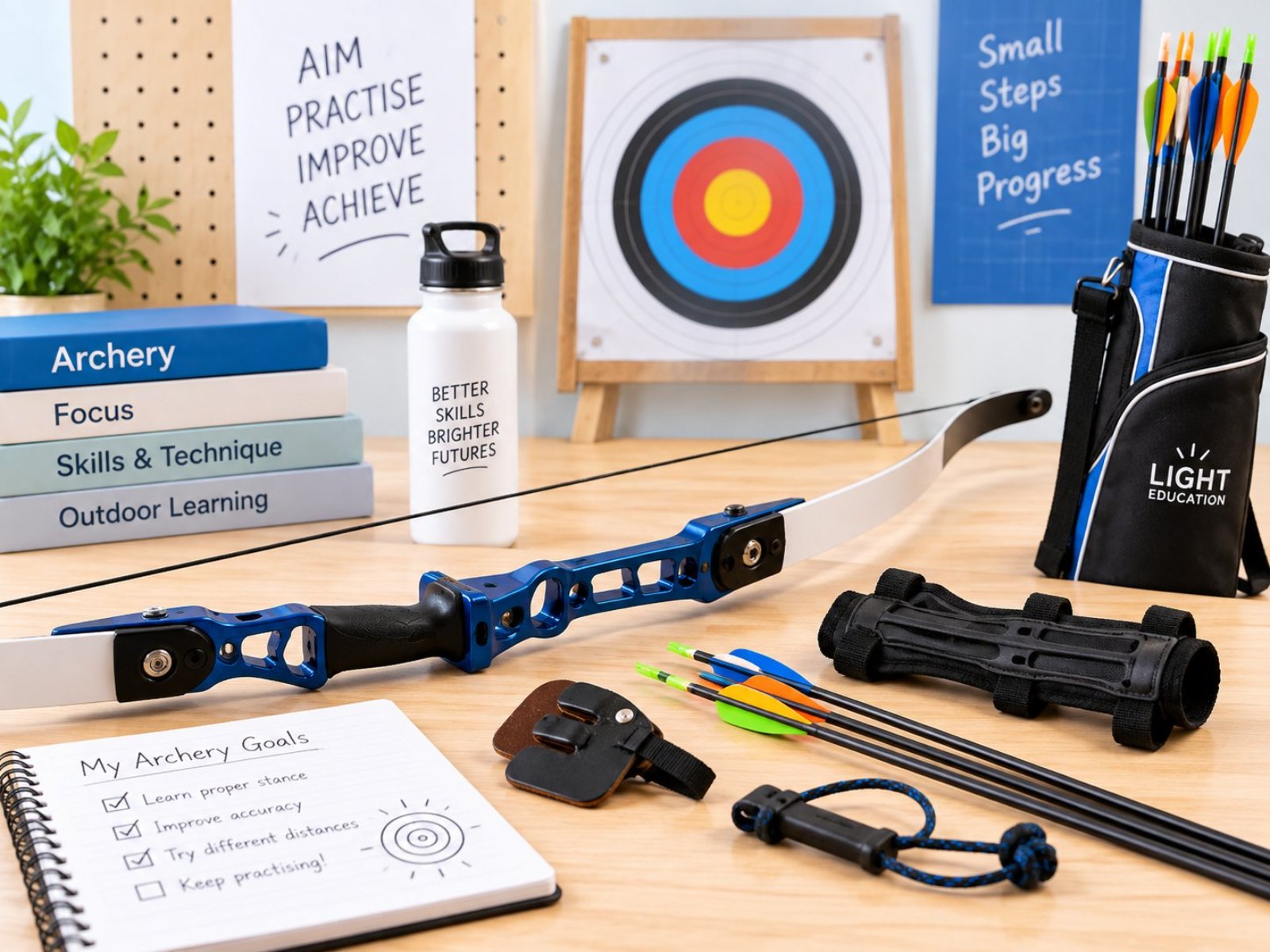 Photo: Archery (5:4)
Class details
offline at school
1 hr/week
8–25/class
Indonesian or English
1 teacher per 4–10 students · 2 teachers up to 20 · >20 opens a second class · extra teacher free
A workbook for every level + a kit each semester that students take home (finger guard, arm guard, power belt and more); bows and arrows are provided
Nothing to bring (bows, arrows & protective gear provided)
Open field or hall with a safe shooting lane (min. 10 m)
What every student receives
- Student's own protective gear: finger guard, arm guard, power belt
- Syllabus & assessment book to track progress
- Bows & arrows provided in class
- Report card & progress notes
- Archery certificate each semester
- Photo & video documentation on request
12 levels · 4 stages
Beginner 1–2 · Basic 1–6 · Intermediate 1–2 · Advance 1–2
16 sessions and one book per level
Grades 1–2 in Beginner, grade 3 to high school in Basic 1
2 books · 2 semesters (±1 year)
Grades 1–2
Tools / softwareVery light training bows, suction-cup arrows
- Balance, coordination and target games
- Safety rules and shooting-line commands
- Draw, aim and release at close range
 Sample work Beginner 1
 Sample work Beginner 2
 Sample work Beginner 3
6 books · 6 semesters (±3 years)
Elementary (new students up to high school start here too)
Tools / softwareRecurve training bows, then horse bow
- Nine technique steps, stance to follow-through
- Scoring rounds at 8–15 m with score cards
- Traditional horse bow and a mini competition
 Sample work Basic 1
 Sample work Basic 2
 Sample work Basic 3
2 books · 2 semesters (±1 year)
After Basic, mostly middle school
Tools / softwareILF/FITA recurve and compound bows
- Assembling and setting up recurve and compound bows
- Scoring rounds at 18–30 m, field permitting
- Mental training, a shot journal and equipment care
 Sample work Intermediate 1
 Sample work Intermediate 2
 Sample work Intermediate 3
2 books · 2 semesters (±1 year)
After Intermediate, mostly high school
Tools / softwareILF/FITA recurve, compound, horse bow, 3D targets
- Basic bow tuning and official competition rules
- Field archery and 3D targets
- Coaching younger students and a school tournament
 Sample work Advance 1
 Sample work Advance 2
 Sample work Advance 3
For every school level
Every student follows the same path; the starting point, pace and depth of the work match their age.
- Starts at
- Beginner 1 (grades 1–2) or Basic 1
- How they learn
- Very light bows and suction-cup arrows first, short distances, lots of target games and teacher help.
- Sample work
- Animal Target Hunt, First 30 Arrows
- Starts at
- Basic 1
- How they learn
- One book per semester, from basic technique to a 10 m scoring round.
- Sample work
- Gold Hunter Round, Horse Bow Festival
- Starts at
- Basic 1 (new) · Intermediate (continuing)
- How they learn
- Faster pace; moves on to ILF/FITA recurve and compound bows.
- Sample work
- Mini Competition, 18 m Ranking Round
- Starts at
- Basic 1 (new) · Advance (continuing)
- How they learn
- Independent, tuning their own bow, up to a school tournament.
- Sample work
- Qualification Round, School Tournament
- Starts at
- Custom class · can continue to Intermediate
- How they learn
- Topics, number of sessions and schedule set with the school; recreational archery, fitness and team-building.
- Sample work
- A horse bow round, safe archery games for school events
From the Archery classroom
 Photo: Archery 1
 Photo: Archery 2
 Photo: Archery 3
 Photo: Archery 4
 Photo: Archery 5
Questions about Archery
Does the school need a special room?
Open field or hall with a safe shooting lane (min. 10 m).
What do students need to bring?
Nothing to bring (bows, arrows & protective gear provided).
How many students are in one class?
Capacity: 8–25/class. One teacher guides 4–10 students; up to 20 students get two teachers; above 20 a second class opens. Extra teachers at no cost.
How long do students stay in this programme?
There are 12 levels in four stages: Beginner 1–2, Basic 1–6, Intermediate 1–2 and Advance 1–2. One level is one semester (16 sessions) with its own book, so students can continue for years.
How is it different for elementary and high school?
The path is the same, but the starting point, pace and depth of practice differ. Grades 1–2 start in Beginner; new students from grade 3 to high school start in Basic 1, with middle and high schoolers moving faster and more independently. See "For every school level".
Is there a class for parents or teachers?
Yes. Adult classes are custom-built with the school: topics, number of sessions and schedule are agreed together. Participants who want to continue can move on to the Intermediate stage.
Which equipment is used, and what should students bring?
Nothing: bows and arrows are provided, and the protective kit is theirs to take home each semester. Beginner uses very light bows and suction-cup arrows, Basic uses recurve training bows and the horse bow, and Intermediate and Advance use ILF/FITA recurve and compound bows. The school provides an open field or hall with a safe shooting lane of at least 10 m.
Can the class run online?
No. This programme runs offline at school only, because it needs equipment and hands-on supervision.
Can the school try it first?
Yes. We run a free demo class or ASA Expo at your school before enrolment opens.