
Origami
Kids learn basic folds and how to read diagrams to shape paper. Skills grow from single-sheet pieces to modular models with more varied shapes and colors.
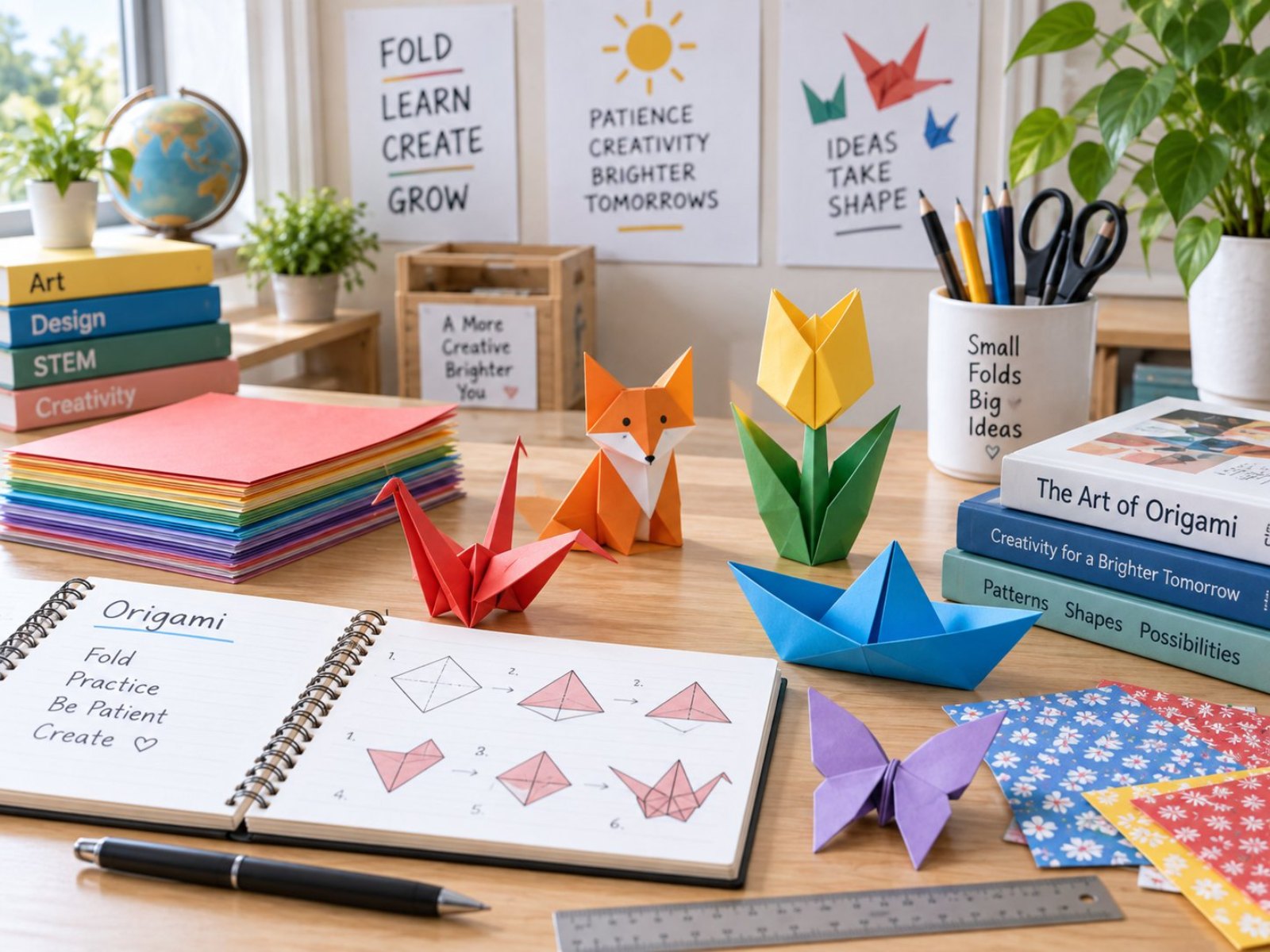 Photo: Origami (5:4)
Class details
offline at school · online available
1 hr/week
8–25/class (offline) · 50 (online)
Indonesian or English
1 teacher per 4–10 students · 2 teachers up to 20 · >20 opens a second class · extra teacher free
A guidebook for every level + origami paper in many sizes; every model is folded without glue and taken home
Nothing to bring (all materials provided)
Classroom (and outdoor area for some activities)
What every student receives
- Origami pieces taken home every session
- Toolbox, tools & origami paper
- Workbook & video tutorials
- Report card & progress notes
- Origami certificate each semester
- Photo & video documentation on request
12 levels · 4 stages
Beginner 1–2 · Basic 1–6 · Intermediate 1–2 · Advance 1–2
16 sessions and one book per level
Kindergarten in Beginner, elementary to high school in Basic 1
2 books · 2 semesters (±1 year)
Kindergarten (K1–K2)
Tools / software15 and 20 cm origami paper, crayons; no scissors
- Tearing, folding in half and pressing neat creases
- Animal faces and models from triangle folds
- Following 1–2–3 step pictures and a diorama
 Sample work Beginner 1
 Sample work Beginner 2
 Sample work Beginner 3
6 books · 6 semesters (±3 years)
Elementary (new students up to high school start here too)
Tools / software10–25 cm origami paper, paper strips; no glue
- Basic folds and kite, square and triangle bases
- Animals and objects: crane, jumping frog, box
- Modular origami and a bird of their own design
 Sample work Basic 1
 Sample work Basic 2
 Sample work Basic 3
2 books · 2 semesters (±1 year)
After Basic, mostly middle school
Tools / softwareThin and thick paper, bone folder, scissors, spray bottle
- Grids, twist folds, tessellations and Miura-ori
- Kirigami, pop-ups and 30-unit modulars
- Detailed creatures: box-pleating and wet-folding
 Sample work Intermediate 1
 Sample work Intermediate 2
 Sample work Intermediate 3
2 books · 2 semesters (±1 year)
After Intermediate, mostly high school
Tools / softwareLarge paper, stylus; optional Oripa/Inkscape for crease patterns
- Reading and designing their own crease patterns
- Origami engineering and a display for a client brief
- Hanging installation, photographing work and a portfolio
 Sample work Advance 1
 Sample work Advance 2
 Sample work Advance 3
For every school level
Every student follows the same path; the starting point, pace and depth of the work match their age.
- Starts at
- Beginner 1
- How they learn
- Simple tearing and folding, fully guided by the teacher.
- Sample work
- Triangle Fish, My Paper Pond
- Starts at
- Basic 1
- How they learn
- Slower pace, following diagrams with the teacher.
- Sample work
- Tulip, jumping frog, crane
- Starts at
- Basic 1
- How they learn
- Starting to read diagrams alone and assemble modulars.
- Sample work
- Lidded box, Sonobe cube, My Signature Bird
- Starts at
- Basic 1 (new) · Intermediate (continuing)
- How they learn
- Faster pace; fold patterns, pop-ups and detailed creatures.
- Sample work
- Sonobe cube, Square Twist Tile, Pop-up City Card
- Starts at
- Basic 1 (new) · Advance (continuing)
- How they learn
- Independent, designing their own models up to an exhibition installation.
- Sample work
- My Designed Insect, Hanging Installation, Origami Portfolio
- Starts at
- Custom class · can continue to Intermediate
- How they learn
- Topics, number of sessions and schedule set with the school; work that is useful right away for decorations, packaging and teaching aids.
- Sample work
- Masu box, gift packaging, pop-up building card
From the Origami classroom
 Photo: Origami 1
 Photo: Origami 2
 Photo: Origami 3
 Photo: Origami 4
 Photo: Origami 5
Questions about Origami
Does the school need a special room?
Classroom (and outdoor area for some activities).
What do students need to bring?
Nothing to bring (all materials provided).
How many students are in one class?
Capacity: 8–25/class (offline) · 50 (online). One teacher guides 4–10 students; up to 20 students get two teachers; above 20 a second class opens. Extra teachers at no cost.
How long do students stay in this programme?
There are 12 levels in four stages: Beginner 1–2, Basic 1–6, Intermediate 1–2 and Advance 1–2. One level is one semester (16 sessions) with its own book, so students can continue for years.
How is it different for kindergarten and high school?
The path is the same, but the starting point, pace and depth of work differ. Kindergarten starts in Beginner; new students from elementary to high school start in Basic 1, with middle and high schoolers moving faster and more independently. See "For every school level".
Is there a class for parents or teachers?
Yes. Adult classes are custom-built with the school: topics, number of sessions and schedule are agreed together. Participants who want to continue can move on to the Intermediate stage.
Which materials are used?
Beginner uses 15 and 20 cm origami paper and crayons, with no scissors. Basic uses 10–25 cm origami paper, rectangles and paper strips, all without glue. Intermediate adds thin and thick paper, a bone folder and scissors for kirigami. Advance uses large paper and can use the free software Oripa or Inkscape for crease patterns.
Can the class run online?
Yes. Classes run offline at school, and an online version is also available.
Can the school try it first?
Yes. We run a free demo class or ASA Expo at your school before enrolment opens.